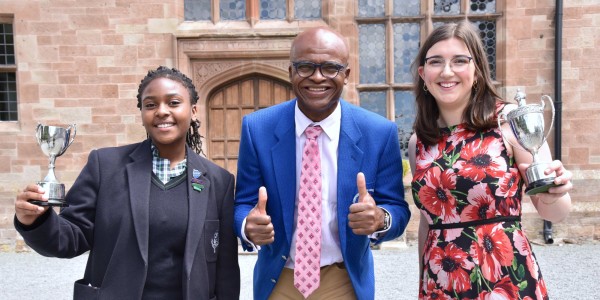
Athletics legend Kriss Akabusi told students to “dream big”, seize opportunities and embrace people who recognise their potential when he was the guest of honour at a Shropshire School’s Speech Day and prize-giving.
The triple Olympic medallist and holder of World, European and Commonwealth titles was at Adcote School, in Little Ness, near Shrewsbury, to award prizes to students and inspire them with a fascinating talk about his journey from a London children’s home to the athletics podium.
Talking to an audience of 450 people, including students, their parents, teachers and dignitaries, the former 400m hurdler and sprinter described the lessons he had learned in life.
He told students that to reach their potential they needed to take responsibility for themselves, make decisions, take opportunities, be ready to accept and learn from others, accept that there will always be challenges and understand that, no matter how successful or talented they were, there would always be times in their lives when they would need the help and support of others.
Kriss Akabusi was one of the biggest names of the Great Britain athletics squad of the mid 1980s and ‘90s, smashing records and winning a haul of Olympic, World, European and Commonwealth medals.
He was born to well-educated Nigerian parents in the UK. When they returned to their native Nigeria, after independence, to help rebuild the country, they decided that he should stay behind in the UK to benefit from a British education. But, after the outbreak of civil war in Nigeria, funding from his parents dried up and he found himself living in a children’s home.
He admits he was “a clown” at school but, at 16, joined the British Army. It was there, sometime later, that his athletics potential was spotted by Army sergeant Ian McKenzie who gave him his first running spikes, planned a training schedule and encouraged him to compete. Soon Akabusi’s talent on the athletics track was being spotted at a higher level.
“He was an army athlete as well as a soldier. He transformed my life!” Akabusi told the audience.
Kriss found fame at the 1984 Los Angeles Olympic Games where he won a silver medal – a medal that he particularly treasures and keeps with him at all times to this day.
Probably his best-remembered race of the era was when the Great Britain 4 x 400m relay team of Roger Black, Derek Redmond, John Regis and Kriss Akabusi spectacularly beat the indomitable USA to take gold at the 1990 World Championships.
Akabusi ran a blistering anchor leg to overtake the American 400m individual world sprint champion Antonio Pettigrew, and held him off to finish first over the line.
Glory had come after a daring change in the Great Britain running order at the last minute – an idea that had come to Akabusi himself, he revealed, in the early hours of the morning before the race.
“I saw that the whole world ran a race that suited the Americans,” he said.
A race that, by the time the runners would have got to the final lap, the Americans would already be many metres up on everyone else and impossible to chase down.
It was Roger Black, the fastest runner in the team, who was meant to have been running the final leg. Kriss had the idea of switching the running order by putting Black and Redmond, the second fastest Brit, on the first two laps of the race to give Great Britain the lead over the entire field in the first half or two-thirds of the race. This would give Kriss the best chance of fighting off Pettigrew and snatching victory in the final leg.
“Whoever you are, whatever your background, dream big,” Kriss told students.
“And think about the impact you’re making in lives, not just your own but those around you.”
His greatest individual triumph was winning the gold medal in the 400m hurdles at the 1990 European Championships when he broke a British record that had stood for 22 years.
After he retired from the track, in 1992 Kriss was awarded an MBE by the Queen for his services to British athletics.
He went on to become a radio and TV broadcaster, best known as a presenter for Channel 4’s ‘The Big Breakfast’ and the BBC children’s show ‘Record Breakers’. He continues to work as a consultant and contributor for radio and TV. Over the past 20 years, he has also made a name for himself as a motivational speaker.


Editor is the team behind Love Shrewsbury keeping you up to date with news and events.
Recent Post