This is not the first time I have driven an Ineos Grenadier. In March 2023, after what felt like having to wait for an eternity, Ineos invited me to The Glanusk Estate near Crickhowell to sample their all-new 4×4. However, not only was the Grenadier then new, so too was Ineos Automotive.
A little recap before we go on. The story goes, a little like this… Sir Jim Radcliffe, Britain’s richest man, owner of Ineos, the world’s third largest chemical company, tried to buy the rights to manufacture the old (some might say, last proper) Land Rover Defender when JLR decided it no longer could. JLR would not sell. Type approval also played its hand in killing off the previous generation Defender too.
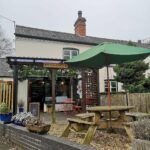
Recognising an old Land Rover type sized gap in the market, Jim set about building his own four-wheel drive, no nonsense, go-anywhere workhorse; one that would utilise some of the best automotive components his not inconsiderable wealth could buy. He spent £1.3 billion, set-up, Ineos Automotive, and the Grenadier was born. However, the plan wasn’t to make just one vehicle: the plan was to make a whole range of them. The name incidentally, comes from The Grenadier, the pub Jim owns on Belgrave square.
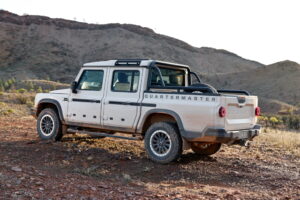
Hence, the Grenadier we have here: The Quartermaster.
This one’s in Fieldmaster spec. A Trialmaster is another option. You may recognise those names come from the motorcycle jacket maker Belstaff, – they’re another brand in the Sir Jim Radcliffe portfolio. Still, I suppose we should be grateful he didn’t take inspiration from anything relating to Manchester United. He owns them too.
The original plan was to manufacture the Grenadier in Brigend, Wales. However, being the devoted (deluded?) Brexiteer he is, Radcliffe and Ineos Automotive later confirmed that production, which started in 2022, would take place in the former Mercedes Benz plant in Hambach, on the Franco-German border. Clearly, the European Union still has certain benefits, eh Jim?
At over a foot longer than the standard Grenadier station wagon, the 5 seat, crew cab, Quartermaster pick-up is, I suspect, probably one of the largest “passenger cars” (I’m using the term lightly) you can drive on a standard UK car license. It is nearly five and half metres long, over two metres tall, and is very nearly two metres wide – and that’s before you account for the door mirrors. It boasts an eight hundred millimetre wading depth, two hundred and sixty-four millimetres of ground clearance, and weighs in at nearly two and three-quarter tonnes, dry. It is enormous. This is not the thing to take into the Tesco car park on the last Saturday afternoon before Christmas. The turning is over fourteen metres, and it’s over four turns lock to lock.
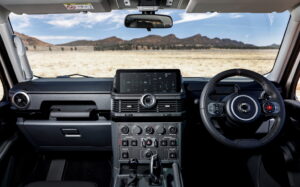
Haul yourself up into the Quartermaster’s heated Recaro driving seat and slam the door shut – it requires a hefty pull due to the double-seal that aids waterproofing – and instantly, you feel invincible. Everything feels as purposeful as you’d hoped it might. There are big, chunky switches for locking the diffs you can operate with gloved hands, large levers for selecting low ratios, rubber mats, skylights you can pop out completely, and a compass and altimeter amidships on the dash.
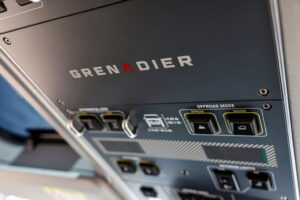
There is even a row of prewired, auxiliary rocker switches, mounted in the roof panel; they’ve been fitted in anticipation of the all the extra lights and winches owners might want to fit. A five tonne winch is actually a factory-fit option, as are uprated front springs to go with it. Even the thick-rimmed steering wheel comes with an extra-large horn button. It all feels a bit like sitting in the cockpit of a military helicopter.
The ignition barrel is buried deep in the dash, near your left knee, turn the good old-fashioned ignition key and the BMW straight-six – petrol in this particular case – soon settles into idle. A diesel BMW straight-six is also available and offers even more torque,
The gear selector is BMW sourced too, pull it back into Drive, release the proper, leather wrapped lever-type handbrake (hoorah for that!) and you’re away, the recalibrated ZF box slipping through its 8 ratios smoother than many an executive saloon.
Those squared-off corners, the elevated seating position, and Ineos’s decision to mount the (again BMW sourced) infotainment display centrally, atop the dash, make the view ahead all-but unhindered. Thus, thankfully you can place the Grenadier with ease.
The ride is firm, and typically live axle, but never jarring. Progress is surprisingly swift enough for something the best-part of nearly 3-tonnes in weight. There’s little body-roll despite the mass and higher centre of gravity, and the Grenadier can be punted along, where space allows, with ease.
Although, the bug-bear for some will be the steering. Off road, where the Grenadier never seems phased by anything, the low ratio recirculating ball system means there is little if no kickback should you inadvertently hit something solid or drop unexpectedly into a gulley or ditch. The payoff however, is that on road there is virtually no self-centring, and not much in the way of feedback either. You have to get used to it; you can find yourself sawing at the wheel, weaving up the road as you struggle to find the straight-ahead position. Granted, the Grenadier was never conceived to be a Sports SUV, nevertheless a slight sharper reaction time surely wouldn’t have done any harm at all.
Then, there’s the driver’s side footwell. On right-hand drive Grenadier’s, in order to make space for the exhaust system, there is quite the intrusion in the floor-pan right where you’d ideally like to put your left foot. The result is you drive the Grenadier with your right leg sticking out somewhere towards the A-pillar – the accelerator feel as if it’s set way over to the right – and your left leg curled-up underneath you, your knee nearly knocking the indicator stalk. It’s not quite as uncomfortable as it sounds – for a while at least. However, after a long-schlep somewhere you arrive with a left leg having fallen asleep long before the rest of you is allowed to. It’s not a problem on left hand drive Grenadiers I’m told – handy perhaps if you too happen to be Monaco residing tax exile like Sir Jim.
There are other niggles too. Because in Quartermaster spec the Grenadier is so heavy, its payload suffers. You can’t carry a tonne in the back because to do so would mean the gross vehicle weight would exceed three and half tonnes, and that’s the maximum weight you’re allowed to drive on a car standard license. Rear seat space is stingy to say the least, especially so in the centre seat. Fuel consumption, even in the diesel, is little more than high-teens – and significantly less if you try to make progress or couple-up a trailer; the Grenadier will tow three and a half tonnes with ease. Because it classed as a commercial vehicle (N1) you’re limited to 50mph on A-roads, and 60mph on dual carriageways.
There is also the asking price… With options, albeit over ten-grand’s worth – “my” Grenadier Quartermaster Fieldmaster rang the tills at £80,218. You could probably four second hand Mitsubishi L200s for that, carry over a tonne in each, and claim the VAT back. You pays your money…
Unless, you’re about to tackle some kind of world-record beating expedition, or you really have to have a vehicle such as this – I’ll let you try to come up with the exact reason – it’s incredibly difficult to suggest quite why you’d ever need a Grenadier Quartermaster. This is a working tool: it is not a luxury SUV by any stretch of the imagination.
However, needing and wanting are entirely different things. I’ve driven the Quartermaster, every day, for over a week. It is flawed, it is heavy, it’s huge, it’s thirsty, it’s expensive, and everyone around here thinks it’s a fake Land Rover. I’ll never need one; I can’t afford one. Nevertheless, none of the above stops me missing it now it’s gone.
Ineos Grenadier Quartermaster Fieldmaster
Engine: 2,993cc 24 Valve, BMW B58 straight-six, turbo charged, petrol
Transmission: 8-Speed ZF automatic. Selectable high and low-range four wheel drive.
Power: 286 bhp @ 4,750 rpm
Torque: 332 lbft @ 1,750 – 4,000 rpm
0 – 62 MPH: 8.8 Sec
Max Speed: 99 mph
CO2: 325 – 336 g/km
MPG: 18.9 – 19.6 (combined)
Price: from £69,995 (as driven £80,218)
Many thanks to Matt and Lois at PFPR

Simon Palfrader ©



Recent Post