This job certainly isn’t get any easier, y’know! Finding something new to write about the latest variation on a theme makes you wonder sometimes if you haven’t written it all before, about something similar, somewhere else. And especially-so since nearly every car manufacturer you can think of seems to have reduced the size of their range. Where are all the saloon cars these days? Where are the MPVs? What happed to all the superminis and city cars that once used to be parked on every suburban street corner? Why doesn’t anyone make estate cars anymore? What happened to variety?
What happened? The SUV happened, that’s what. Every car maker you can think of makes an SUV these days, even the so-called exclusive ones. No, let’s rephrase that: Every car maker you can think of, now makes a range of SUVs – even the so-called exclusive ones! And even more-so now they’re all going electric.
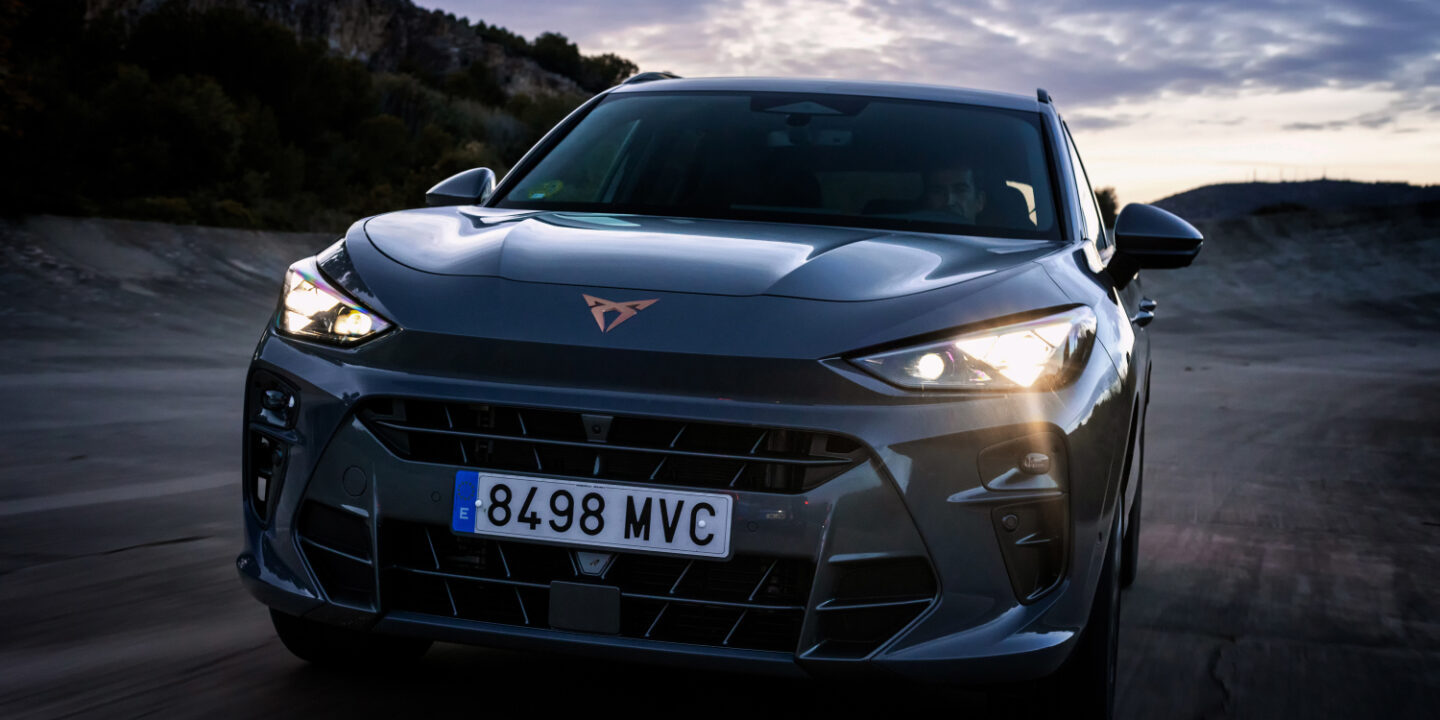
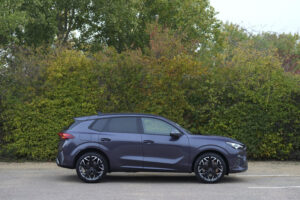
My latest case in point is the car you see before you: The Cupra Terramar. It’s an unashamedly sporty and supposedly brand new SUV from a brand, once a sub-brand of a brand (SEAT) that was once considered the sporty sister brand to a very well-known German brand (VW): a brand that once made everything – city cars, saloons, estate cars, you name it. Now though they predominately make a range of SUVs, more and more of which are, inevitably, electric.
Not only that, but Cupra’s new Terramar has been brought out to replace… you’ve guessed it, their outgoing SUV. After seven years, Cupra’s Ateca – a car which I happened to like quite a lot in fact – is now no longer seen as fitting the Cupra brand ethos quite enough (It was essentially a souped-up SEAT). Cupra’s mission, apparently, is to “create exponential experiences and transcend traditional automotive boundaries”. Whatever that means?
Beneath the Terramar’s heavily sculpted and deliberately muscular bodywork is what is essentially either a Volkswagen Tiguan or a Skoda Kodiaq. They’re all more or less mechanically identical. That means, currently at least, you can have your Terramar with a variety engine options – some hybrid; some purely petrol-powered. There is no diesel option however, such are these environmentally conscious times.
There are two hybrids, both utilising VW’s 1.5-litre petrol engine connected to a six-speed DSG auto gearbox and an electric motor. You can choose a power output of either 201bhp or 268bhp, and both come with a 25.8kWh battery (of which 19.7 kWh is usable). Electric only range is a claimed 76 miles in the lesser-powered version and 74 miles in the sportier one. I can tell you now, you’ll get less. Hybrid Terramars are front-wheel drive only and will rapid charge, I’m reliably informed, at speeds of up to 50kW.
The purely petrol range starts with a front wheel drive, 148bhp 1.5-litre turbo four-pot (albeit with a little bit of mild-hybrid assistance). Next up is a 2.0-litre turbo four-cylinder with 201bhp, after which comes the 261bhp version such as the one Cupra’s always lovely PR lady was kind enough to lend me for a few days. Both 2.0 litre variants of the Terramar send their power to all four wheels, and all petrol Terramars get the VAG group’s seamlessly slick shifting seven-speed DSG gearbox.
As yet, you can’t have a purely-electric Terramar. If that’s what really you want, you’ll have to wait until the already planned second generation one arrives, by which time it will have moved further upmarket partly as a result of it being underpinned by the same platform as (fellow VAG group members) the Porsche Macan Electric and Audi’s Q6 E-tron.
One other thing of note powertrain-wise: The current generation Terramar is said to be the last new Cupra product that will be fitted with an internal combustion engine. Progress, eh?
And what of that engine?
In its more potent 261bhp/295lbft form, VW’s familiar 2.0 litre lump provides a more than adequate oomph when required, despite the DSG having been programmed to pick the highest gear it can in a bid to maintain maximum efficiency. You should get mid 30s mpg.
Of course, you can switch to the sportier Cupra mode, but in doing so you also switch on some very artificial sounding, and quite frankly superfluous, fake engine noises that are pumped into the cabin via the 9 Sennheiser speakers. It’s all best left turned off to be honest, and especially-so on rougher surfaces. Thankfully elsewhere, and with both a softer damper setting and a more soothing and more natural sound track selected, the Terramar proves itself as quite the comfy cruiser. Thankfully you can switch the majority of the ADAS (driver-assist) systems off too, via a button mounted on the flat-bottomed, and heated, steering wheel.
Do you need four-wheel drive in something that looks as if it’s been designed to stray no further off-road than a gravel track at the entrance to Centre Parcs? Probably not. Nevertheless, the extra driven wheels do bestow this particular Terramar with a 2,200kg maximum towing weight. Handy perhaps if you’re more the caravanning type.
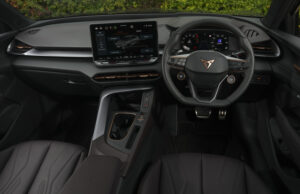
Which, I suppose, brings us around to the Terramar’s interior. Think angular design, copper coloured accents, led mood lighting, faux suede, and fake metallic plastic. Put like that it all actually sounds pretty hideous, but in reality it all works rather nicely, looks quite attractive, and feels surprisingly pleasant to the touch. The seats are comfy, and heated, the driving position is good, and everything has that familiar, premium, Volkswagen-esque feel of solidity.
Except that is, for the new steering column mounted stalk controls. Cupra have adopted VW parent group’s drive selector switch, first seen on VW’s electric ID series models. It sits where, traditionally, the wiper stalk use to be. As a result of said twisty lever, the left hand column stalk now has to control, wipers and washers both back and front, indicators, and flash/dip/high beam. It feels as is if someone somewhere, in their infinite wisdom, decided to junk a whole generation’s worth of near perfect and instantly familiar VAG group ergonomics, all in a bid to save a few pennies. And don’t get me started on the touch sensitive sliders that supposedly adjust the heating, or the oversized infotainment screen that looks like it belongs in a Curry’s showroom window.
Am I being over critical? Perhaps a little. The Terramar is actually a rather a nice thing to spend time punting along in. But then, so too is much of its competition. The whole concept of Cupra is to try to offer something a little edgy; something a little different. Minor switchgear niggles aside, as much as I appreciated the Terramar, it still left me wondering if what it actually offers is something different enough.
Cupra Terramar 2.0TSi 265PS 4Drive
Engine: 1,984cc, 4 Cylinder, 16 valve, turbo-charged petrol
Transmission: 7-speed dual clutch sequential 4 Drive DSG auto, with manual mode.
Power: 261 bhp @ 5,000 – 6,500 rpm
Torque: 295 lbft @ 1,650 – 4,350 rpm
0-62 MPH: 5.9 Sec
Max Speed: 151 mph
CO2: 191 g/km (WLTP)
MPG: 32.1 – 33.6 (WLTP combined)
Kerb Weight: 1,750kg
Price: rrp. £47,885 (As driven £49,450)
Many thanks to Katie at Cupra’s UK press office for the loan of the Terramar
@bird_liam


Recent Post